If the public has limited attention and motivation, how can message design optimize memory and persuasive outcomes?
Under what conditions is processing difficulty useful for enhancing message effectiveness?
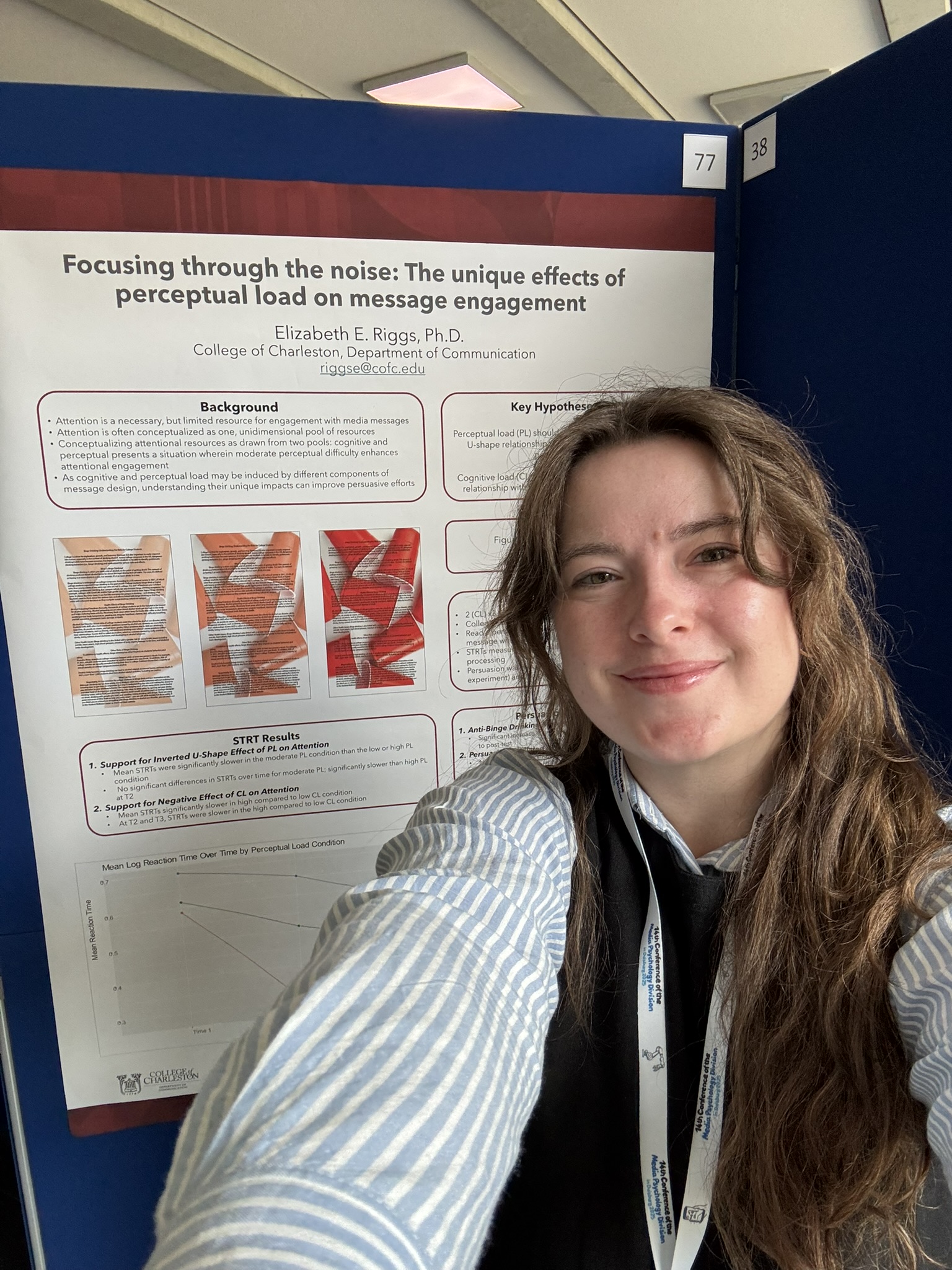
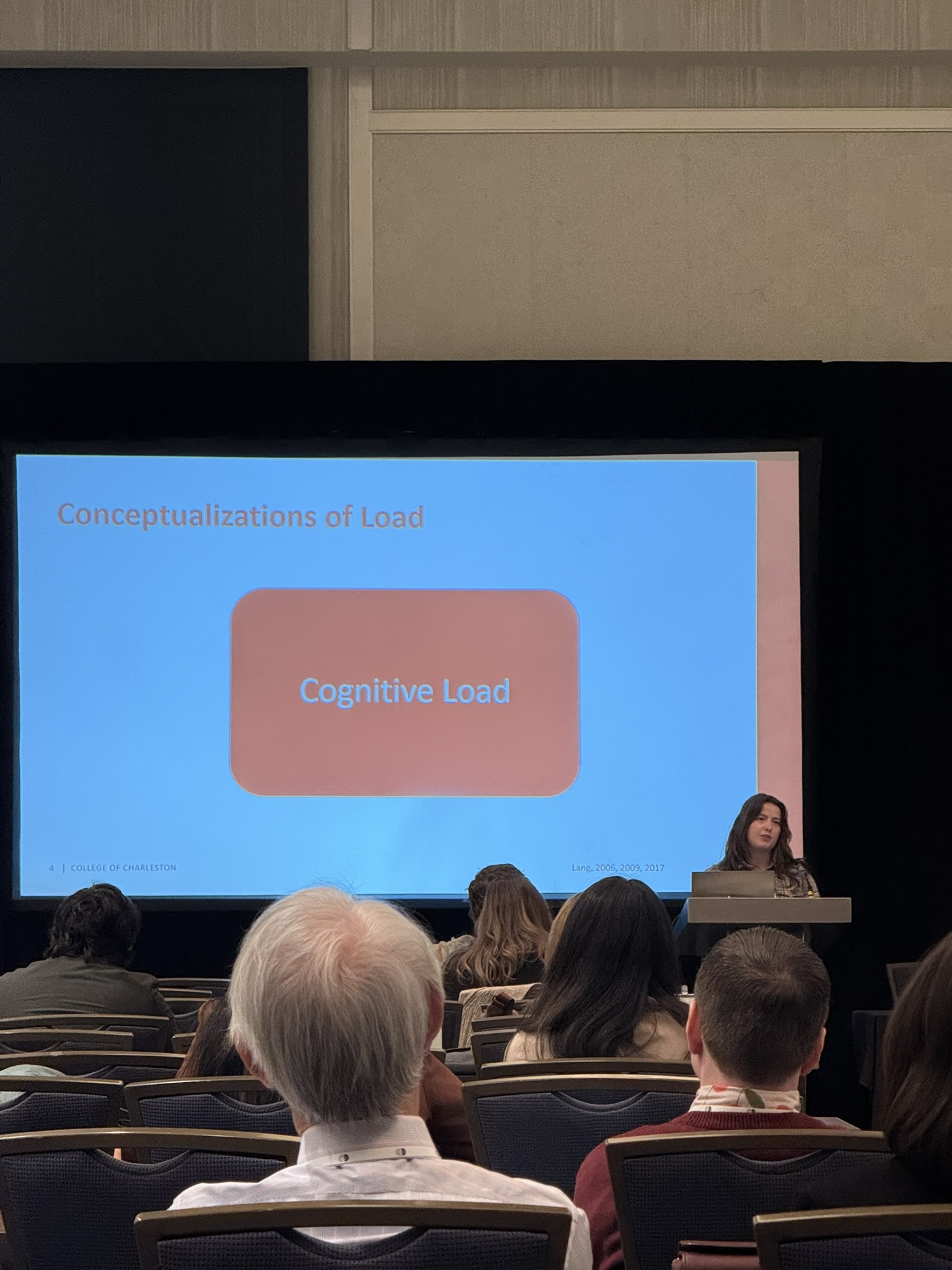
My research program centers human attention limitations as the focal mechanism shaping message engagement across science, health, and political communication contexts.
Additionally, my research questions are closely intertwined with measurement and methodological decisions . I employ quantitative methods, including experiments and surveys, and measures such as eye-tracking and secondary task reaction times. I am often interested in assessing the gap between objective and subjective message engagement, comparing self-reports to behavior and unconscious processes.
Publications
Attention & Load
- Riggs, E. E., Shulman, H. C., Huskey, R., Lynch, T., & Fisher, J. T. (2025). What can cognitive load and processing fluency tell us about difficult processing? Media Psychology, 1–27. https://doi.org/10.1080/15213269.2025.2576679
- Yang, X., Riggs, E.E., Coronel, J.C., Krajbich, I. (2026). Issue importance amplifies the effect of gaze on voting decisions. Cognition, 268, 106376. https://doi.org/10.1016/j.cognition.2025.106376.
- Riggs, E.E. (2026). Easy to understand, easy to see: Conceptual and perceptual fluency drives news headline selection. Journal of Language and Social Psychology. https://doi.org/10.1177/0261927X261424551
- Riggs, E.E., & Knobloch-Westerwick, S. (2024). Losing awareness of our surroundings? The role of attention during transportation into audio narratives. Journal of Media Psychology. https://doi.org/10.1027/1864-1105/a000400
Strategic Communication
- Fort, K. S., Lopez, R., Shulman, H. C., Riggs, E. E., & Cruz Ibarra, J. (2024). The impacts of code-mixing in a cross-cultural narrative: How processing fluency impacts narrative engagement and attitudes toward out-groups. Communication Research, 0(0). https://doi.org/10.1177/00936502241287334
- Riggs, E.E. & Knobloch-Westerwick, S. (2022). Beyond the text: Testing narrative persuasion mechanisms with audio messages. Mass Communication and Society, 1-25. https://doi.org/10.1080/15205436.2022.2065304
- Shulman, H.C., Holt, L.F., Riggs, E.E., & Wade, R. (2025). The role of framing, race, and symbolic racism in policy support. Political Communication, 0(0). https://doi.org/10.1080/10584609.2025.2463923
- Riggs, E.E., Shulman, H.C., & Lopez, R. (2022). Using infographics to reduce the negative effects of jargon on intentions to vaccinate against COVID-19. Public Understanding of Science, 31(6), 751-675. https://doi.org/10.1177/09636625221077385
- Shulman, H.C., Bullock, O.M., & Riggs, E.E. (2021). The interplay of jargon, motivation, and fatigue while processing COVID-19 crisis communication over time. Journal of Language and Social Psychology, 40, 546-573. https://doi.org/10.1177%2F0261927X211043100
Quantitative Measurement
- Riggs, E.E., Coronel, J., & Shulman, H.C., (2026). Eye-tracking as a powerful tool for investigating language processing in messages. In T. Reimer, L. Van Swol, & A. Florak (Eds), The Routledge Handbook of Communication and Social Cognition. Routledge/Taylor and Francis.
- Riggs, E. E., Shulman, H. C., Huskey, R., Lynch, T., & Fisher, J. T. (2025). What can cognitive load and processing fluency tell us about difficult processing? Media Psychology, 1–27. https://doi.org/10.1080/15213269.2025.2576679
- Riggs, E.E., & Knobloch-Westerwick, S. (2024). Losing awareness of our surroundings? The role of attention during transportation into audio narratives. Journal of Media Psychology. https://doi.org/10.1027/1864-1105/a000400

 Elizabeth E. Riggs PhD